Aerospace Engineer · MS Candidate 2026
MS candidate at Auburn University researching some of the most extreme propulsion environments in aerospace. Building simulation tools for Formula One on the side, because the physics of going fast doesn't stop at the atmosphere.
I grew up obsessed with two things: going fast and making things work under pressure. Rockets satisfied the first. Formula 1 satisfies both.
I'm an MS candidate at Auburn University completing my degree in late 2026. My research centers on, rotating detonation rocket engines (RDREs), one of the most demanding propulsion environments in aerospace research, conducted in collaboration with NASA Marshall Space Flight Center.
Before Auburn, I earned my BS from USC, where I was project leader in the undergraduate rocket propulsion lab that achieved the first amateur rocket space shot. Engineering has always been a team sport for me, from three years captaining a FIRST Robotics team to collaborative research environments today.
Physics-informed Monte Carlo race strategy simulator modeling the probabilistic decision space of Formula One. Tire degradation physics, VSC/safety car logic, DNF reliability model, and the full 2026 calendar. Live and in active development.
Live →Designed, built, and tested a modular ASI for RDRE applications. Interchangeable choked orifices independently control mass ratio and chamber pressure from a shared supply. 30 tests, zero hardware failures. Published and presentedat AIAA SciTech 2026.
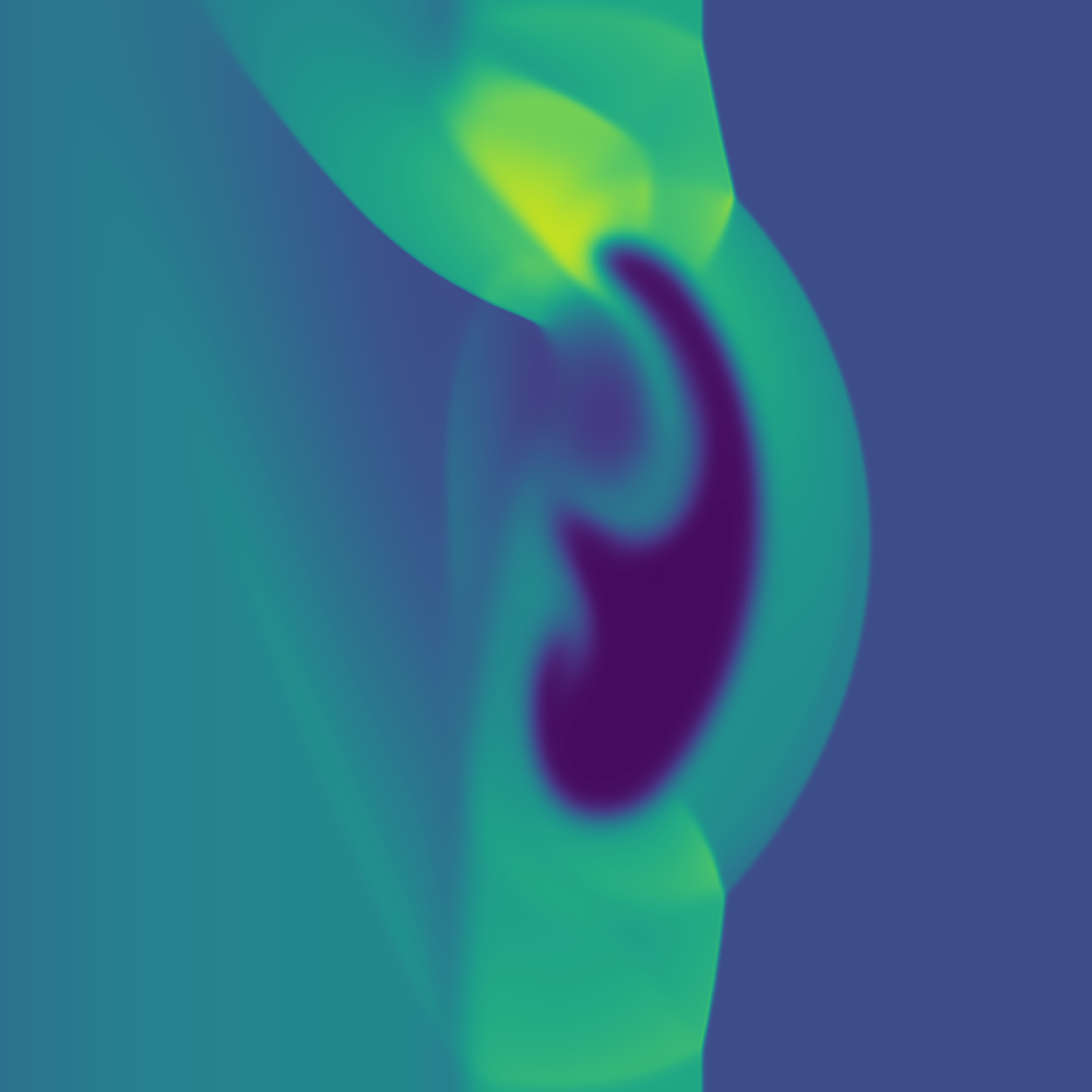
2D compressible Euler solver implemented from scratch in Python. Captures Richtmyer-Meshkov instability growth, shock transmission through a density interface, and full crescent deformation of the bubble. RK4 time integration with artificial viscosity stabilization.
Pressure acoustics eigenfrequency model in COMSOL capturing coupled manifold-injector-chamber acoustic modes. Multi-type mesh strategy across geometric regions. Objective statistical method for automated acoustic wave classification. ITAR-controlled results.
Experimental characterization of 7 AP composite solid propellant formulations at −50°C. Cryogenic tensile testing across curative type and solids loading variables. IPDITMP at 89% solids loading identified as highest-strength formulation. Published and presented at AIAA Aviation Forum 2022.